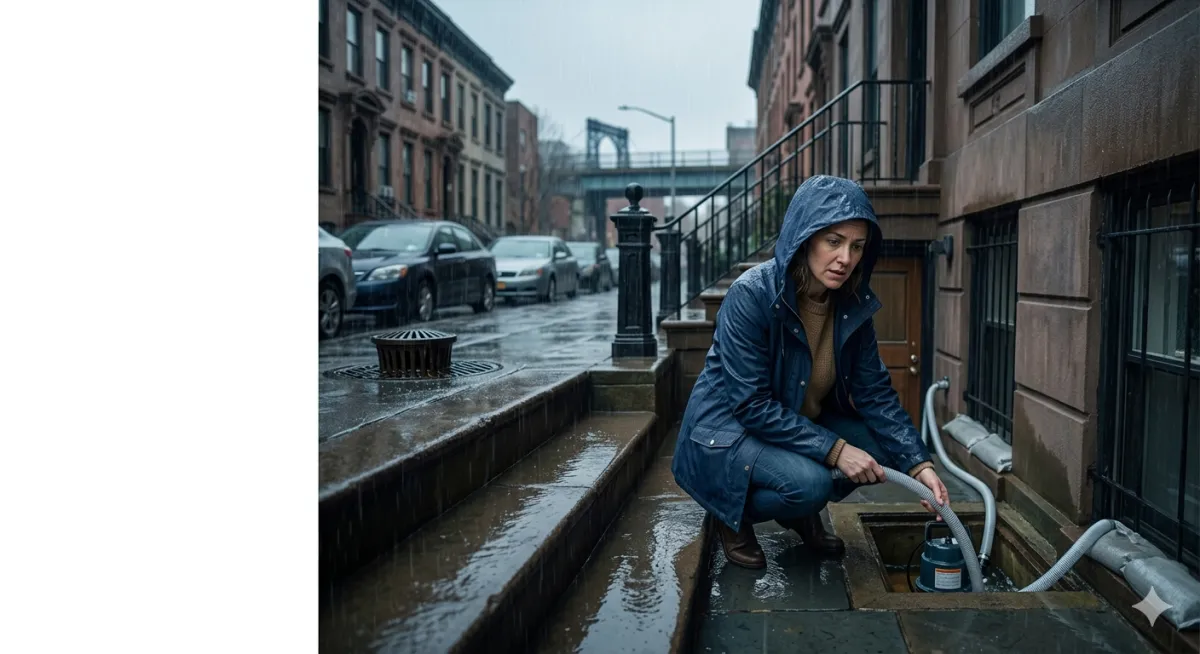
Spring Rains & Sump Pumps: Preventing Flash Flood Damage in Park Slope & Gowanus | Flooded Brooklyn
If I own or manage a garden-level apartment, brownstone basement, or ground-floor commercial space in Brooklyn, spring rain does not feel like a background weather event.
It feels personal.
That is especially true in neighborhoods like Park Slope and Gowanus, where heavy rain can go from inconvenient to destructive very quickly. NYC DEP says climate change is bringing more sudden and powerful storms with more intense rainfall to New York City, and NYC Emergency Management warns that homes with basements or below-grade spaces are especially vulnerable during flood events.
That is exactly why sump pumps matter so much. FEMA’s homeowner flooding guidance says sump pumps help remove accumulated water from basements, and NYC’s flood-preparedness materials specifically advise property owners to make sure sump pumps are working before storms hit.
For a company like Flooded Brooklyn, this topic is not theoretical. Flooded Brooklyn’s own site positions the business around 24/7 emergency response, 30-minute response times, and fast water extraction services across Brooklyn. Its blog also explicitly says it serves neighborhoods, including Park Slope.
Why do spring rains hit Park Slope and Gowanus differently?
Not every Brooklyn flood looks the same.
Some properties flood because stormwater overwhelms local drainage. Some get seepage through foundation walls. Others take on water through cellar doors, low windows, or sewer backups. NYC’s Stormwater Resiliency Plan explains that New York City’s drainage system is extensive but under stress during major rainfall events, and NYC DEP says stronger rainfall is making local flooding more frequent and more intense.
That makes neighborhoods with older housing stock, lower-level units, and vulnerable basements especially stressful during heavy rain. And for Gowanus water damage, the risk conversation often includes not only water volume, but contamination concerns depending on what the floodwater picked up along the way. NYC Health warns that basement floodwater may be contaminated by sewage, and NYCEM says floodwater may also contain oil or gasoline.
So when I think about flood prevention in these neighborhoods, I am not only thinking about keeping floors dry. I am thinking about stopping a water event before it becomes a structural, sanitation, and mold problem.
The sump pump is not the whole plan, but it is a huge part of it
A lot of people think of a sump pump as a nice extra.
In flood-prone conditions, it is closer to a frontline defense.
FEMA says a sump pump installed in a basement can help remove accumulated water, and its spring flood guidance specifically recommends sump pumps with backup power so they can still function if outages happen during a storm. NYC’s flood-preparedness materials also tell homeowners to make sure sump pumps are operational before heavy rain hits.
That matters because the worst time to discover a sump pump problem is:
during a downpour
after water has already crossed the floor
when the power is flickering
when water is rising faster than buckets or wet vacs can handle
For basement pump out Brooklyn situations, the goal is never just “remove water eventually.” The goal is to stop water from sitting long enough to damage drywall, flooring, wood trim, wiring, insulation, and air quality.
Flooded Brooklyn’s site speaks directly to this urgency. Its East New York page says the company provides 24/7 emergency water extraction using high-powered pumps to remove standing water before it spreads into subflooring and wall materials.
What a sump pump can and cannot do?
This is important to understand.
A sump pump can help manage water that enters the basement or sump pit. It can reduce the amount of standing water and help limit damage. But it does not solve every flooding scenario by itself.
If the real issue is:
sewer backup
major groundwater intrusion
foundation failure
power loss without backup
blocked discharge line
contaminated floodwater
then the pump is only one part of the response. FEMA’s mitigation materials note that sump pumps help control seepage and reduce flood damage, but they work best as part of a broader flood-risk strategy.
That is why smart prevention in Park Slope or Gowanus usually means pairing the sump pump with:
regular testing
proper discharge routing
power backup
drainage awareness
quick post-storm response if water still enters
NYC DEP’s flood-preparedness presentation specifically advises homeowners to make sure sump-pump discharge extends 10 to 15 feet beyond the building, which is a practical detail many people overlook.
Why “just pump it out” can be the wrong move?
This is one of the biggest mistakes I see after basement flooding.
People understandably want the water gone immediately. But if the basement water is contaminated by oil, fuel, or sewage, pumping it out without the right sequence can spread contamination across the space. NYC Health specifically warns that if oil is floating on basement water, it should be removed before pumping the water out, as walls and floors can end up coated in oil residue. It also provides specific sewage-cleanup disinfection warnings.
NYCEM also warns that floodwater may be electrically charged or contaminated, which means entering and handling a flooded basement can be dangerous even before cleanup begins.
That is exactly why recurrent flooding in places like Gowanus is not just a “pump and mop” problem. In some cases, it is a professional mitigation problem from the start.
Go to Sewage Cleanup, especially for property owners worried that storm flooding may include backup contamination.
What would I do before the next heavy rain event?
If I were trying to prevent flash-flood damage before the next NYC storm, I would focus on the boring things that actually matter.
1. Test the sump pump before storm season
Do not assume it works because it worked once. NYCEM specifically tells property owners to ensure sump pumps are operational.
2. Make sure discharge is routed away from the building
NYC DEP’s flood-preparedness guidance says sump-pump hoses or pipes should extend well beyond the structure.
3. Clear nearby drains, catch basins, and gutters if safe
NYCEM advises New Yorkers to clear catch basins, drains, and gutters near their homes before storms or report clogged basins via 311.
4. Know how to shut off utilities safely
NYCEM specifically says homeowners should know how to shut off utilities safely and be prepared if they have below-grade spaces.
5. Have a response plan for when prevention is not enough
Because sometimes the storm still wins. That is where rapid extraction and drying become critical.
Check What Should You Do Immediately After Water Damage in Brooklyn Homes?, which is a strong follow-on resource for emergency response.
Why fast pump-out matters so much in Brooklyn basements?
Once water is in, time becomes the biggest factor.
Flooded Brooklyn’s own blog emphasizes the urgency of immediate response after water damage, and its service pages repeatedly focus on rapid extraction and drying before moisture spreads through flooring, drywall, and structural materials.
That makes sense because flood damage is not static. It grows.
What begins as a few inches of water can quickly turn into:
soaked framing
damaged finishes
lingering humidity
odor
mold risk
bigger insurance documentation problems
That is why Park Slope flood cleanup and basement pump out in Brooklyn are not really about water removal alone. They are about preventing the next layer of damage from setting in.
Why does Gowanus flooding deserve extra caution?
Because not all floodwater is equal.
In some parts of Brooklyn, and especially in lower-lying or infrastructure-stressed areas, floodwater can carry contaminants that change the cleanup approach. NYCEM and NYC Health both warn that floodwater may include sewage, oil, gasoline, or electrical hazards.
So for Gowanus water damage, I would be particularly careful about assuming a flood is “clean water” just because it came in during rain. The right response may need:
extraction
sanitation
moisture mapping
material removal
odor treatment
possibly biohazard precautions
That is another reason Flooded Brooklyn’s positioning around specialized restoration, not just generic cleanup, is relevant. Its sewage-cleanup page explicitly calls Category 3 water a biohazard and says it requires trained handling and decontamination.
How did Flooded Brooklyn solve this exact problem?
Based on its website, Flooded Brooklyn is built for the kind of recurrent heavy-rain scenario this article is about.
The company highlights:
24/7 emergency service
30-minute response times
Brooklyn neighborhood service coverage
rapid water extraction
sewage and contamination cleanup
restoration-focused follow-through
And importantly for this article, its own blog explicitly lists Park Slope among the neighborhoods it serves.
Visit the Flood Cleanup Blog for prevention and response resources, especially for homeowners who know flooding is not a one-time event.
Final thoughts
Spring rain in Brooklyn is not automatically a disaster.
But in neighborhoods like Park Slope and Gowanus, it can become one quickly if the basement is vulnerable, the sump pump is not ready, or the response is too slow. NYC agencies and FEMA all point to the same basic reality: heavier rains, below-grade spaces, contaminated floodwater risks, and sump-pump readiness all matter more now than many property owners realize.
That is why prevention starts before the storm, and flood cleanup starts the minute water gets in.
For anyone looking for Park Slope flood cleanup, Gowanus water damage, or basement pump out Brooklyn, that makes sump-pump readiness and fast local response two of the smartest forms of protection you can have.
