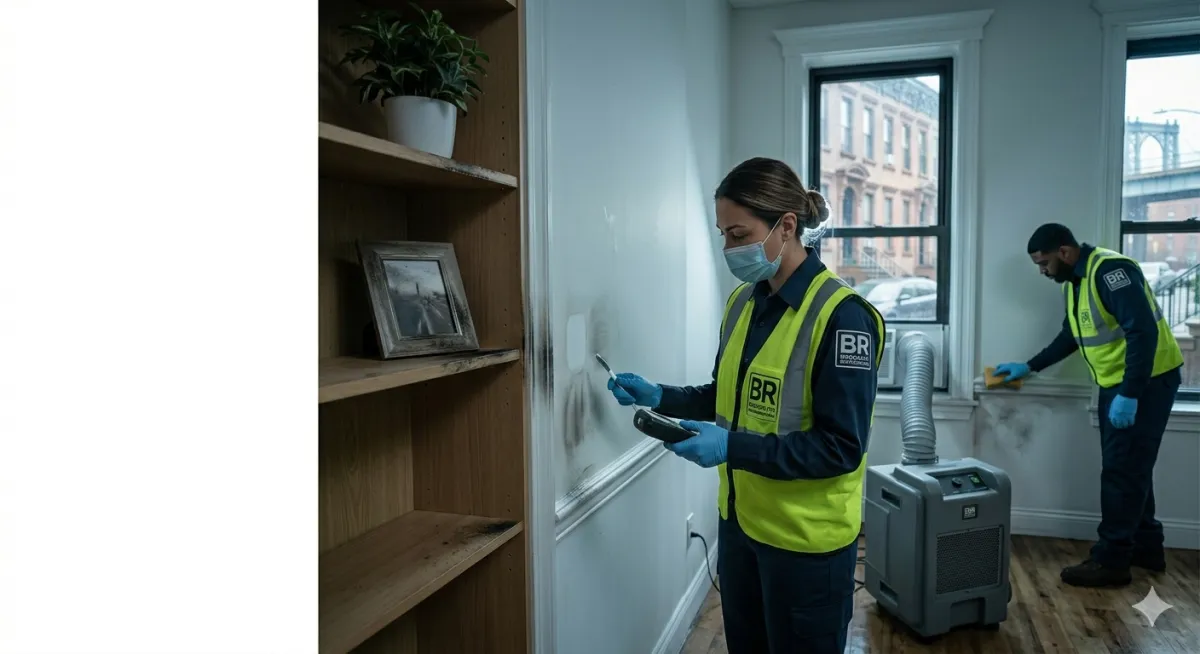
Soot and Odor: Professional Fire Damage Restoration in Bedford-Stuyvesant | Flooded Brooklyn
If I have been through a kitchen fire or an electrical fire in Brooklyn, I know the visible flames are only part of the problem.
What lingers afterward is often worse: the smoke smell that will not leave, the black residue on trim and walls, the fine soot that keeps showing up on surfaces, and the feeling that the air inside the property is still not right. The EPA explains that particles such as soot and smoke are forms of particulate matter, and the CDC warns that ash and soot disturbed during cleanup can irritate the eyes, nose, throat, and skin and can cause coughing or breathing difficulty, especially if the particles become airborne again.
That is exactly why post-fire cleanup is not just a housekeeping job. It is a restoration job.
For Flooded Brooklyn, this topic fits the company’s services directly. Its site lists Fire Damage Restoration among its core offerings, says it provides 24/7 emergency service and 30-minute response times, and notes that it serves Bedford-Stuyvesant among other Brooklyn neighborhoods. On its Crown Heights location page, the company describes how certified experts handle fire cleanup, smoke odor removal, and insurance coordination after kitchen or electrical fires.
Why is soot more serious than it looks?
One of the biggest mistakes people make after a fire is assuming that if the flames were limited, the damage must also be limited.
That is rarely true.
Soot is not only messy. It is particulate contamination. The EPA defines particulate matter as a mixture of solid particles and liquid droplets in the air, including visible material like dust, dirt, smoke, and soot. The CDC’s ash-cleanup fact sheet adds that ash contains larger and tiny particles, including soot, that can become airborne again during cleanup and irritate the respiratory system.
That matters because soot does not stay politely where the fire started. It settles into:
walls
ceilings
vents
fabrics
porous brick
trim
high ledges
hidden interior surfaces
That is one reason Flooded Brooklyn’s site talks about fine soot settling into high ceilings and intricate moldings after residential fires in Brooklyn buildings.
Why does the smell of smoke linger so long
Smoke odor is one of the most frustrating parts of post-fire cleanup because it makes the property feel damaged even after the visible mess is reduced.
That lingering odor happens because smoke residues and particulates settle into porous materials and continue releasing odor over time. EPA’s indoor air guide specifically lists fire damage: soot, odors, chemicals as indoor air quality issues that require proper cleaning, including HVAC components and, in some cases, disposal of damaged furnishings or materials.
That means the smell is not just “in the air.” Often, it is in the materials.
So if I am dealing with smoke odor removal NYC concerns after a Bed-Stuy fire, I do not want a superficial deodorizing job. I want the source addressed.
This is where Flooded Brooklyn’s own service language matters. On its Crown Heights page, it says its certified experts neutralize heavy smoke odors trapped in porous brickwork and restore the property so it is safe and breathable again.
Why DIY cleanup can make soot problems worse?
I understand why people want to wipe everything down and get back to normal quickly.
But soot cleanup is one of those jobs where the wrong method can make the space worse. The CDC warns that ash and soot on indoor surfaces can be inhaled if they become airborne when you clean up, and EPA guidance on indoor air quality emphasizes source removal and proper cleaning rather than simply masking odors.
That means if I:
scrub soot aggressively
use the wrong vacuum
dry-dust contaminated surfaces
turn on the HVAC without checking the system
try to perfume over the smoke odor
I may end up redistributing particles rather than removing them.
That is one reason professional soot cleanup Brooklyn service matters. The goal is not just to make the place look cleaner. It is to reduce residue and airborne recontamination.
Kitchen and electrical fires are especially deceptive
A lot of residential fires in Brooklyn are not catastrophic structure fires.
They are smaller kitchen fires, overheated appliances, electrical surges, and localized smoke events that still leave major contamination behind. Flooded Brooklyn’s site specifically references kitchen fires and electrical surges as common fire-damage events in Brooklyn multi-family buildings and notes that the fine soot is often the “real enemy” after the flames are out.
That is a very practical point because many Bed-Stuy properties are older homes, multi-unit buildings, or renovated historic structures with:
detailed trim
porous materials
older HVAC configurations
shared walls
hidden cavities where odor can linger
So even a “small” fire can create a cleanup job that is much bigger than it first appears.
Indoor air matters after the fire, not just surfaces
One of the easiest things to overlook after a fire is air quality.
The EPA says indoor air problems are often driven by particles and gases from indoor pollution sources, and that inadequate ventilation can allow indoor pollutant levels to stay elevated. It also says filtration can be an effective supplement to source control and ventilation.
That matters because post-fire recovery is not only about soot on the walls. It is also about whether the property feels breathable again.
This is one reason a professional fire restoration process usually needs to consider:
source removal
residue cleaning
air cleaning/filtration
HVAC contamination concerns
odor-neutralization work
whether some materials should be discarded
EPA’s indoor air guide explicitly notes that some furnishings and materials may need to be removed after fire damage rather than simply cleaned.
Why do porous Brooklyn buildings hold odor longer?
This is especially relevant in Bedford-Stuyvesant, where many residential properties include brownstone, brick, plaster, wood trim, and older construction details.
Flooded Brooklyn’s site already points to this kind of challenge when it talks about smoke odor getting trapped in the porous brickwork of Brooklyn buildings.
That matters because in an older Brooklyn property, smoke can settle into places that are not obvious:
mortar lines
ceiling coves
wood casings
HVAC dust
closets and storage cavities
soft furnishings
flooring gaps
That is one reason fire damage restoration in Brooklyn is not just a cleaning service. It is a building material problem and an indoor-air problem at the same time.
Why does a fast response help with smoke and soot, too?
People usually understand why a fast response matters after water damage. It matters after fire damage, too.
The longer soot and smoke residue sit, the harder it can be to fully restore surfaces and air quality. Flooded Brooklyn’s website makes rapid response a major part of its identity, with 24/7 emergency service and 30-minute response times highlighted across its pages.
That speed matters because after a fire, the property often needs:
scene stabilization
damage documentation
soot containment
odor mitigation
fast decisions about salvage versus disposal
insurance-friendly records
Flooded Brooklyn also says it helps handle the insurance side of restoration, which matters because smoke and soot losses can be more complicated than people expect.
What professional restoration should be doing that DIY cannot?
If I am hiring out for fire damage restoration in Brooklyn, I want more than labor. I want a method.
A proper post-fire process should be solving for:
residue removal
odor source reduction
air-quality recovery
damaged-material assessment
contamination spread control
insurance documentation
Flooded Brooklyn’s site supports that expectation. Its Crown Heights page says the team handles the full cleanup, including boarding up broken windows, neutralizing smoke odors, and coordinating with insurance, while its broader site emphasizes certified technicians and restoration-specific service.
Visit the Fire Damage Restoration service category or the Contact flow through the site, since the blog and service structure both point users toward emergency help.
Why Bed-Stuy homeowners and tenants should take odor seriously?
A lingering smoke smell is not only unpleasant.
It is often a sign that residues are still present somewhere in the property.
If I can still smell the fire days later, that means the cleanup may not be finished at the source level. EPA’s indoor air guidance supports this logic by linking fire-related soot, odors, and chemicals to indoor air quality issues that require real cleaning and, in some cases, removal of affected materials.
So if I am in Bedford-Stuyvesant and the apartment or house still smells like smoke after the obvious debris is gone, I would not treat that like a small cosmetic issue. I would treat it like a signal that the restoration work is incomplete.
How does Flooded Brooklyn solve this exact problem?
Even though the requested title is Bedford-Stuyvesant-focused, the company’s own site already confirms the pieces that matter most here:
it offers Fire Damage Restoration
it serves Bedford-Stuyvesant among Brooklyn locations
it promotes 24/7 emergency service
it highlights 30-minute response times
it describes real post-fire work such as soot cleanup and smoke odor neutralization in Brooklyn properties
That is enough to make the local fit clear: if a Bed-Stuy property owner is dealing with smoke smell and soot after a kitchen or electrical fire, Flooded Brooklyn is clearly trying to be the kind of local rapid-response restoration company that handles exactly that kind of problem.
Visit our Blogs page for more emergency-preparedness and restoration guidance, and the Sewage Cleanup page only if cross-contamination or broader biohazard concerns are relevant after an incident.
Final thoughts
After a fire, it is easy to focus on the burned area and underestimate the smoke.
But the smoke is often where the recovery battle really is.
Soot is particulate contamination. Smoke odor can stay embedded in porous materials. Ash and soot can become airborne again during improper cleanup. And indoor air quality can stay compromised if the property is not restored correctly. EPA and CDC guidance both support taking those residues seriously, especially when cleanup can stir them back into the air.
For anyone searching for fire damage restoration in Brooklyn, smoke odor removal in NYC, or soot cleanup in Brooklyn after a kitchen or electrical fire in Bedford-Stuyvesant, the real goal is not just to make the space look better.
It is to make it feel safe, breathable, and livable again.
