Water Damage Insurance Claims NYC: Documentation Guide | Flooded Brooklyn
I’ve stood in hundreds of flooded Brooklyn basements and high-rise apartments, and after the initial shock wears off, every homeowner asks me the same thing: "Will my insurance actually pay for this?"
In New York City, the answer isn't always simple. Dealing with insurance adjusters in the five boroughs is like navigating the subway at rush hour, it’s fast-paced, crowded with fine print, and if you don't have the right "ticket" (documentation), you’re going to get stuck.
As the founder of Flooded Brooklyn, I’ve learned that a successful water damage insurance claim in NYC isn't won by the person with the most damage; it’s won by the person with the most evidence. Here is my personal guide to building a bulletproof claim while the water is still wet.
The "NYC Burden of Proof": Why Your Photos Matter?
Insurance companies in New York are notoriously strict. They often look for any reason—like "gradual seepage" or "lack of maintenance" to deny a claim. Your job is to prove the damage was sudden, accidental, and significant.
1. The 360-Degree Photo Strategy
When you first discover the flood, do not touch a thing. Grab your phone and start taking photo documentation for floods before you even move a rug.
Wide Angles: Capture the entire room from all four corners. The adjuster needs to see the "scope" of the incident.
The "Water Line": Take close-ups of where the water met the wall. This proves the depth of the flooding.
The Source: If a pipe bursts under your sink, take ten photos of that specific pipe from every angle.
2. Video Walkthroughs with Narration
Photos are great, but a video is harder to dispute. Walk through the affected area and narrate what you see. "I am in the basement of my Park Slope brownstone; it is 10:00 AM on Tuesday, and water is gushing from the main line." This creates a time-stamped, verbal record of the event.
The Paper Trail: Organizing Your "Claim Bible"
Once the water is extracted, the "paper war" begins. At our Brooklyn restoration company, we provide our clients with digital reports, but you should keep your own "Claim Bible."
The Communication Log: Keep a notebook. Every time you speak to your agent or an adjuster, write down the date, time, the person's name, and exactly what they told you. In NYC, verbal promises can vanish into thin air—written logs do not.
Receipts for Everything: Did you buy a mop? Save the receipt. Did you have to stay at a hotel because your apartment was uninhabitable? Save the receipt. These fall under "Additional Living Expenses" (ALE) and are often reimbursable.
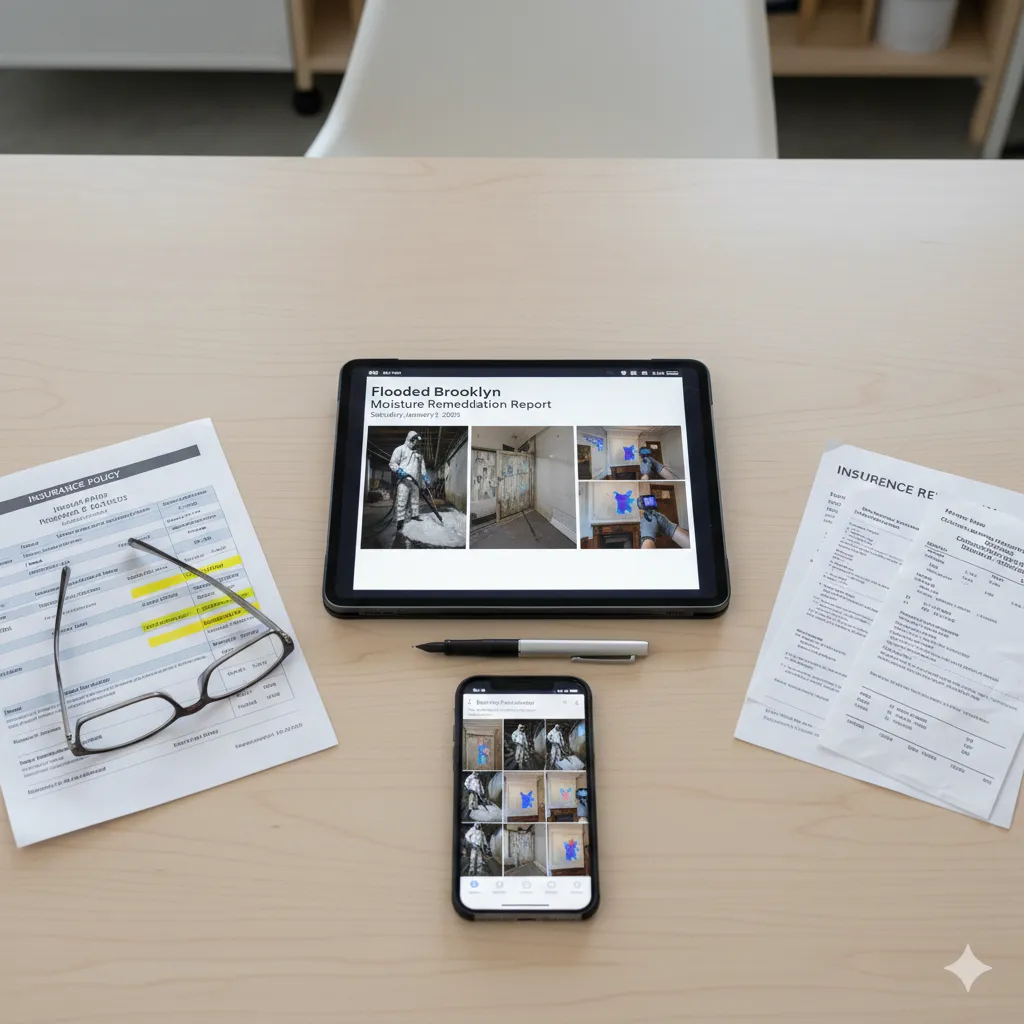
Professional Reports: This is where we come in. We provide thermal imaging scans and moisture maps that prove water is hidden behind your walls. An adjuster can argue with a homeowner, but it’s much harder to argue with a professional infrared report.
The "Don't Toss It" Rule
This is the mistake that kills most Brooklyn claims: Do not throw away damaged items until the adjuster has seen them.
I know the instinct is to get the "trash" out of the house, especially if it’s a sewage backup. However, if you toss an $8,000 Italian leather sofa without the adjuster inspecting it, they may only offer you a fraction of its value, or nothing at all. If you must remove something for health reasons (like moldy food), take a photo of the serial number and the damage first.
FAQs
Q: How do I file a water damage claim with the NYC Comptroller?
A: If your damage was caused by a city-owned water main break or a street sewer backup, you must file a "Notice of Claim" with the NYC Comptroller’s Office within 90 days of the occurrence. This is a separate process from your private insurance.
Q: What is the most common reason for water damage claim denials in NYC?
A: The "Gradual Damage" clause. Insurers will deny a claim if they believe a leak has been happening for weeks. This is why immediate photo documentation for floods is vital, it proves the incident just happened.
Q: Should I hire a Public Adjuster in Brooklyn?
A: For large, complex claims (over $20,000), a Public Adjuster can be a great ally. They work for you, not the insurance company. However, for most standard pipe bursts, a reputable Brooklyn restoration company that provides detailed documentation is usually enough to get a fair settlement.
You Focus on Recovery; We’ll Handle the Proof
The "maze" of NYC insurance doesn't have to be overwhelming. When you choose Flooded Brooklyn, you aren't just getting a cleanup crew; you're getting a partner who knows exactly what adjusters are looking for. We provide the high-tech evidence, from moisture logs to structural drying charts - that forces insurance companies to take your claim seriously.
Would you like me to provide a sample "Insurance Communication Log" template you can use to track your claim from day one?
[Start Your Professional Documentation with Flooded Brooklyn]
