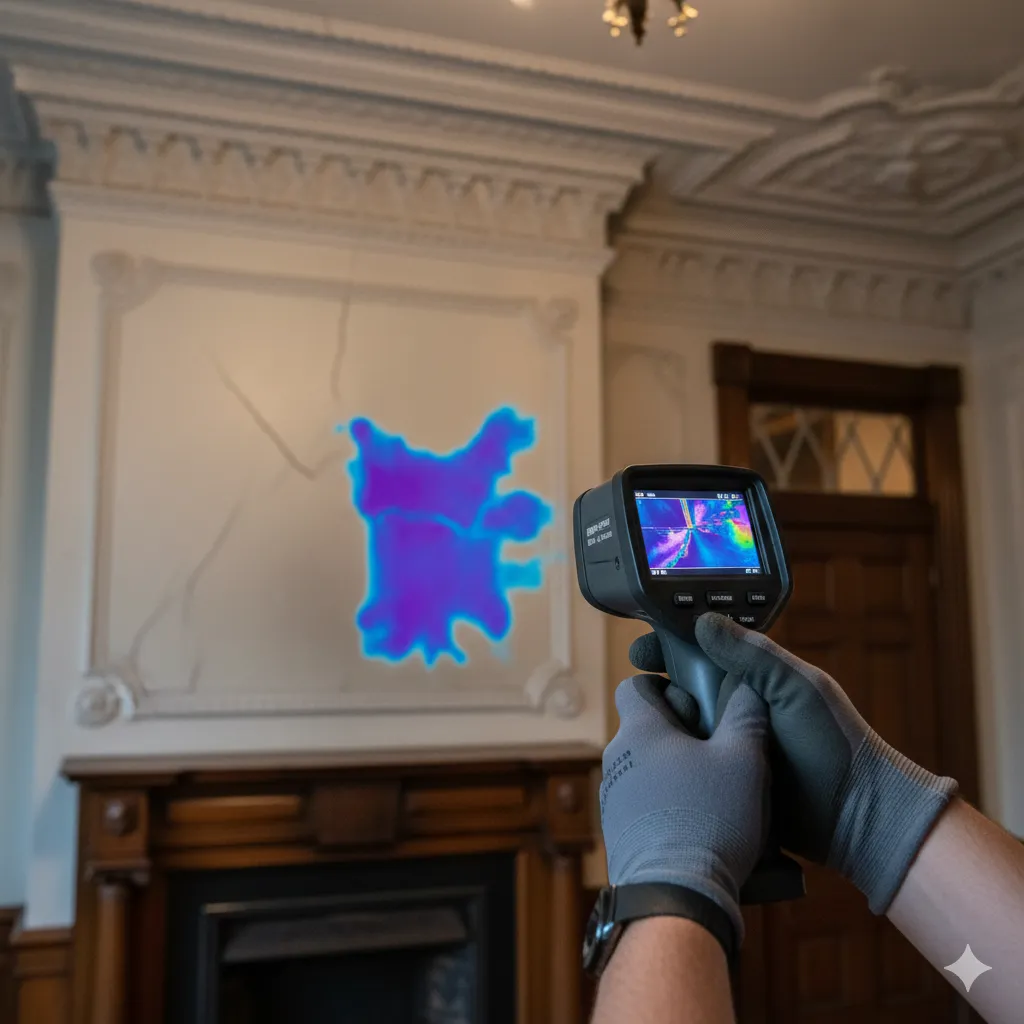
Leak Detection Brooklyn: Hidden Moisture & Thermal Imaging Guide
There is a specific kind of anxiety that comes with owning an older home in Brooklyn. You see a tiny, faint yellow circle on your ornate plaster ceiling, or you notice a slightly musty scent in your Parlor floor hallway. You know something is wrong, but the thought of a contractor "exploring" your walls with a sledgehammer is enough to make you look the other way.
At Flooded Brooklyn, I’ve spent years navigating the "skeletons" of 100-year-old buildings. One thing I can tell you for certain: What you see on the surface is rarely the whole story.
In 2026, we don't have to guess anymore. By using infrared water damage inspection, we can literally see through the history of your home to find the exact source of trouble. Here is why thermal imaging is the ultimate "save" for Brooklyn’s historic architecture.
The Science of "Seeing" the Unseen
A common misconception I hear is that thermal cameras "see through walls" like X-ray machines. That’s not quite right. Instead, these cameras detect minute temperature differences, often as small as 0.1 degrees on a surface.
When water leaks into your home, it changes the thermal mass of your building materials.
Evaporative Cooling: As moisture evaporates from drywall or wood, it cools that spot down. On our infrared screens, a hidden leak appears as a "dark blue" or "purple" ghost-like shape, contrasting against the "yellow" and "orange" of your dry, warm walls.
The Path of Migration: Thermal imaging allows us to perform moisture mapping in NYC. We don't just find the spot; we follow the blue trail back to its origin, whether it’s a pinhole pipe leak, a roof scupper backup, or a failing window seal.
Why Old Brooklyn Homes Need a Non-Invasive Touch?
Brooklyn Brownstones and pre-war apartments are built differently. They utilize lath-and-plaster, solid masonry, and dense hardwoods. These materials are beautiful, but they are also experts at hiding water.
1. Preserving Historic Plaster
Plaster is porous. It can soak up gallons of water before you ever see a drip. By the time a "bubble" appears in the paint, the wooden laths behind it might already be rotting. Leak detection in Brooklyn using thermal cameras catches the moisture when it’s still just a "thermal signature," allowing us to dry it out before the plaster fails.
2. Identifying "Ghost Leaks"
Sometimes, the water you see in your garden-level basement actually started three floors up. Because old homes have settled over time, water often travels along joists and beams in unpredictable patterns. Infrared technology allows us to "see" the entire vertical path of the water without opening a single hole in your drywall.
3. Finding Insulation Voids
In many renovated Brooklyn homes, moisture gets trapped in "dead air" spaces or poorly installed insulation. These damp pockets are the #1 cause of hidden mold. Thermal imaging highlights these cold spots instantly.
FAQs
Q: Can a thermal camera see water behind a tiled bathroom wall?
A: Yes. Because tile conducts heat differently when there is moisture behind it, a thermal camera can often detect "cold zones" beneath bathroom tiles. This is incredibly helpful for finding leaks in shower pans or behind-the-wall plumbing without ripping out expensive tiling.
Q: Is infrared leak detection enough to prove a leak to my insurance?
A: Thermal images are powerful evidence, but we always pair them with moisture meter readings. The camera shows us where to look, and the meter confirms the percentage of moisture. Together, they create a "Moisture Map" that insurance adjusters find very hard to dispute.
Q: How accurate is an infrared water damage inspection?
A: It is highly accurate when used by a trained professional. However, things like "ghosting" (missing insulation) or drafts can sometimes look like moisture. That’s why you need Brooklyn NY restoration experts who know how to interpret the images in the context of old NYC construction.
Stop Guessing. Start Seeing.
If you suspect a leak in your Brooklyn home, don't wait for the ceiling to sag. The longer water sits, the more it compromises the structural integrity of your property.
Our infrared water damage inspection is fast, non-destructive, and can save you thousands in unnecessary "exploratory" demolition. Let Flooded Brooklyn give you a clear, digital picture of exactly what’s happening behind your walls.
Would you like me to perform a "Whole-Home Thermal Scan" to ensure no hidden leaks are lurking in your walls?
[Book Your Infrared Leak Inspection with Flooded Brooklyn]
