Drying Historic Brownstone Hardwood Floors | Flooded Brooklyn
Preserving History: The Science of Drying Original Brownstone Hardwoods Without Cupping
I have spent a major portion of my restoration career working inside the historic neighborhoods of Brooklyn. Walking into a grand brownstone in Park Slope or Brooklyn Heights always fills me with a deep sense of respect for the craftsmanship of the past. These homes feature architectural details that simply cannot be replicated today, from hand-carved mantels to intricate, 120-year-old inlaid parquet and quartersawn oak floors.
But when a plumbing line bursts on an upper floor, that historic beauty is instantly placed in extreme jeopardy. I have met with many homeowners who are absolutely terrified, not just by the water itself, but by the threat of standard, aggressive cleanup tactics. They worry that a generic restoration crew will rip out their irreplaceable exotic floors or use improper drying methods that cause the wood to buckle, crack, and cup beyond repair.
I want to reassure you that a water disaster does not have to mean the end of your home's historic fabric. Wood is incredibly resilient, and by applying advanced preservation science, we can safely save original floors that have stood for more than a century. Today, I want to pull back the curtain on how we extract moisture from antique hardwoods without destroying their original character.
The Unique Vulnerability of Antique Hardwoods
To save an antique floor, you have to understand that old wood behaves entirely differently from modern, engineered planks. The lumber used in historic brownstones was harvested from old-growth forests, making it incredibly dense. It was tightly fitted together, often without the expansive expansion gaps we use in contemporary construction.
When water saturates an old-growth floor, the wood cells slowly drink up the moisture like a sponge. As the boards absorb water, they try to expand. Because the planks are locked tightly against each other and the heavy brick structural walls of the brownstone, they have nowhere to go but up.
This expansion leads to a destructive phenomenon known as cupping, where the edges of the planks rise higher than the centers, creating a wavy, distorted surface. If the moisture level stays elevated for too long, or if the drying process is forced too quickly, the wood cells collapse permanently, causing the planks to split or buckle completely off the subfloor.
Precision Moisture Extraction Over Direct Tearing
The old-school approach to a flooded room was simple: rip everything out to the joists and start over. But when dealing with irreplaceable history, demolition should always be the absolute last resort.
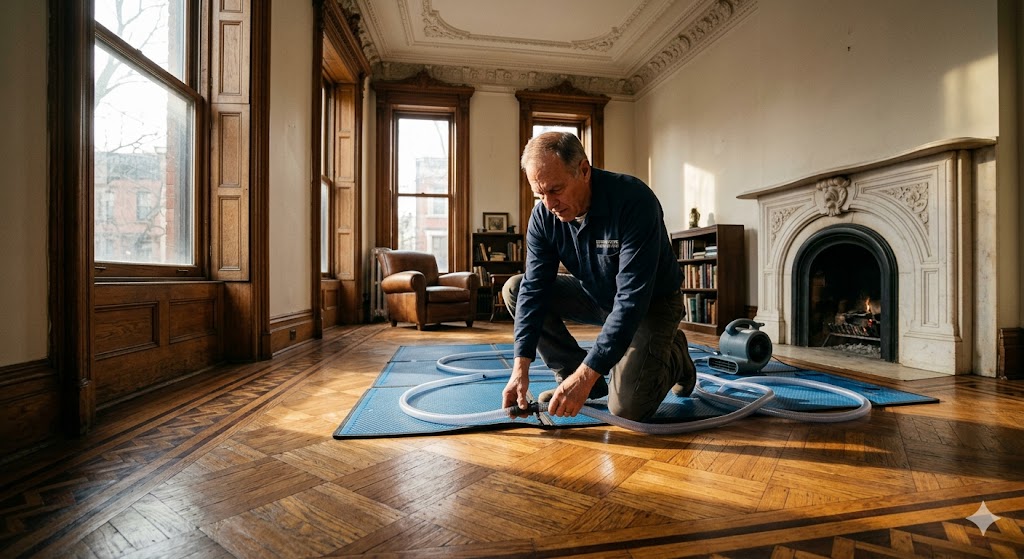
Our approach relies on specialized hardwood floor water extraction systems designed specifically for preservation. Instead of tearing up the wood, we use heavy-duty, non-invasive vacuum panels that seal directly to the surface of the floor. These panels are connected to commercial extraction units that create a powerful negative-pressure environment.
The vacuum literally pulls the liquid water directly out from the tight seams between the planks and the porous subfloor underneath. This immediate, high-volume extraction stops the lateral expansion of the wood cells in its tracks, significantly reducing the pressure that causes severe warping.
Achieving Equilibrium Through Desiccant Dehumidification
Once the standing water is extracted from beneath the surface, the second, more delicate phase of historic home flood repair in Brooklyn properties begins. We have to address the bound water that is deeply trapped inside the cellular structure of the wood itself.
This phase requires absolute patience and precise environmental control. If you blast an antique floor with direct, high-temperature heat, the top layer of the wood will dry faster than the bottom layer, causing severe cracking and structural failure. We avoid this by utilizing commercial desiccant dehumidifiers.
These advanced machines pump incredibly dry, warm air into the room, lowering the relative humidity of the space to a surgical degree. This creates a balanced vapor pressure deficit, drawing the moisture out of the dense wood grain at a controlled, uniform rate. We monitor this progression around the clock using specialized moisture meters, ensuring the floor returns to its dry standard equilibrium without undergoing cellular shock.
Your Trusted Partner for Park Slope Brownstone Restoration
Preserving a historic home requires an understanding of building history and material science. You cannot treat a century-old brownstone like a modern apartment building. Every choice, from how we set up the drying zones to how we navigate the architectural framing, must be done with an eye toward architectural preservation.
At Flooded Brooklyn, we have built our reputation on providing the specialized Park Slope brownstone restoration services that discerning homeowners trust. We do not believe in unnecessary demolition. We use science, advanced technology, and a deep respect for historic architecture to stabilize your home and save your original features. If your historic property has experienced a water emergency, we are here to provide the sophisticated, gentle, and effective care your home deserves.
FAQ
Can historic hardwood floors really be saved after a major flood?
Yes, in many cases, historic hardwood floors can be successfully saved if mitigation begins within the first twenty-four to forty-eight hours. Because old-growth lumber is highly dense, it absorbs water much more slowly than modern engineered woods, giving restoration experts a critical window of time to extract the moisture and dry the structure safely.
What is cupping, and can it be fixed without replacing the floor?
Cupping occurs when the edges of a wood plank warp upward due to a moisture imbalance, where the bottom of the board is wetter than the top. If the wood cells have not been permanently crushed, professional desiccant drying can safely return the wood to its normal, flat state. Once the moisture levels are completely stabilized, any minor remaining imperfections can often be resolved through professional sanding and refinishing.
Why should you avoid using standard heat fans on antique wood floors?
Standard high-heat fans dry the surface of the wood far too rapidly while leaving the underside of the plank saturated. This extreme moisture imbalance causes severe structural stress, leading to deep cracking, checking, and splitting of the historic wood grain. Controlled, balanced dehumidification is the only safe method for antique lumber.
How do you check for hidden water beneath original parquet floors?
We use non-penetrating, radio-frequency moisture meters and high-resolution infrared thermal imaging cameras. These tools allow us to see directly through the dense wood surface and map pockets of trapped moisture in the subfloor without drilling holes or damaging the historic finish of your floor.
Conclusion: Honoring the Past with Modern Science
A water leak in a historic home is undeniably stressful, but it does not have to mark the end of your property's original character. The craftsmen who built the classic brownstones of Brooklyn used materials designed to last for generations, and with the right scientific approach, those materials can survive modern accidents.
By choosing high-tech vacuum extraction and precise, balanced dehumidification over destructive demolition, you protect your home's historic integrity and your long-term property value. You deserve a team that values your home's history as much as you do.
If you are facing a property emergency and want to ensure your historic features are preserved by true specialists, we invite you to reach out to us. Visit our website at Flooded Brooklyn to learn more about our structural preservation systems or call our emergency line to get an expert team on-site immediately.
