From Demo to Done: Why You Need a Full-Service Reconstruction Team in Brooklyn | Flooded Brooklyn
If I have ever gone through water or fire damage, I know one of the most frustrating moments is not always the emergency itself.
It is what happens after the emergency crew leaves.
The water is gone.
The fans stop running.
The moisture readings improve.
But then I look around and realize I still have no finished walls, no usable floors, and no one clearly responsible for getting the property back together.
That is the contractor gap, and it is one of the biggest reasons property owners feel stuck after restoration. Flooded Brooklyn’s website is built around solving that exact problem by offering not only emergency mitigation, but also Reconstruction Services Brooklyn alongside water, fire, mold, sewage, and commercial restoration. Its homepage describes the company as a total-property-recovery team handling cleanup and reconstruction, with 24/7 emergency service, 30-minute response time, and all insurance accepted.
Dry does not mean done
This is the first thing I wish more property owners understood.
Drying the structure is critical, but it is not the same thing as finishing the job. A property can be professionally extracted, dehumidified, sanitized, and stabilized, and still be completely unlivable or unusable. Flooded Brooklyn’s service pages make this distinction very clearly by separating Water Damage Restoration from Reconstruction Services, which shows that mitigation and rebuilding are two different stages of recovery.
That matters because a lot of people think the hardest part ends when the property stops actively deteriorating.
In reality, that is often where the second problem starts.
The “contractor gap” is where delays multiply
If I do not have a full-service team, the process often breaks into pieces.
One company handles extraction.
Another one may do demolition.
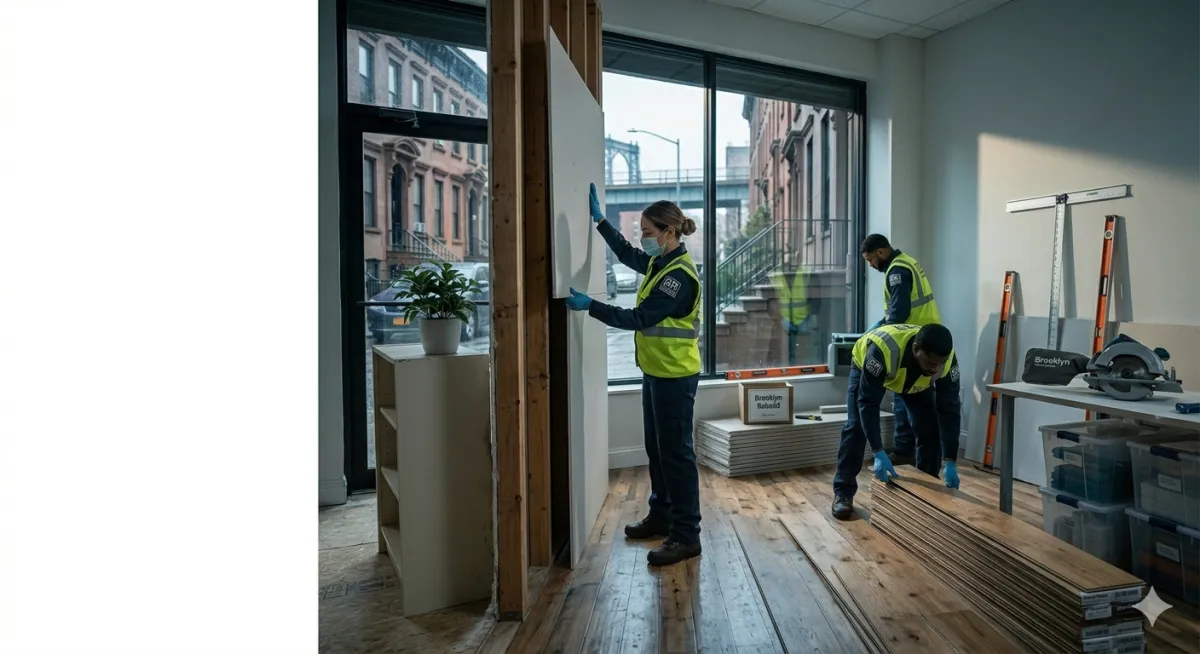
Then I start looking for someone else to rebuild drywall, replace trim, repair flooring, repaint, and get things back to normal.
That is where time gets lost.
Flooded Brooklyn’s location and service pages repeatedly emphasize that the team handles every aspect of the restoration process and provides recovery from cleanup through reconstruction. On the Vinegar Hill page, the company says its reconstruction team is dedicated to seamless results and handles everything from replacing drywall to restoring floorboards.
That is exactly why a full-service approach matters. It keeps the project moving instead of forcing the owner to rebuild the team from scratch midway through the crisis.
Water damage repair in NYC is rarely just a drying job
A lot of people imagine water damage repair in NYC as mostly a matter of pumping out water and setting up air movers.
But once the mitigation phase ends, the real repairs can include:
drywall replacement
insulation replacement
subfloor repair
trim and molding work
repainting
floor restoration
ceiling repair
cabinet or built-in repair
Flooded Brooklyn’s site consistently frames its service model as total property recovery, and its homepage includes reconstruction right alongside the core cleanup services.
That matters because if I am trying to get back to normal, I do not want the project to stop at “we dried it.” I want the property restored to usable condition.
Fire damage has the same rebuild problem
This issue is not unique to water losses.
After fire or smoke damage, the cleanup phase may involve soot removal, air scrubbing, odor treatment, and safety work. But after that, many properties still need real rebuilding. Flooded Brooklyn’s service pages describe Fire Damage Restoration as including board-up work, soot removal, smoke-odor neutralization, and HEPA-filtered air scrubbing, while also offering reconstruction as part of the broader recovery path.
So whether the loss began with water, fire, sewage, or mold, the same structural truth often follows: the building may be stabilized, but the owner still needs someone to put it back together.
Why do property owners get stranded after a demo?
Demo creates urgency because it exposes exactly how much still needs to be rebuilt.
Once wet drywall is cut out or damaged, finishes are removed, and the property becomes visibly incomplete. That is where owners often feel the pressure all at once:
now the damage is fully exposed
the property still looks like a job site
regular life cannot resume
and the next contractor has not been lined up yet
Flooded Brooklyn’s pages suggest the company is trying to prevent that handoff failure. Its homepage and neighborhood pages emphasize that the company is set up for full-cycle recovery, not just emergency response.
That is exactly what a full-service reconstruction team is supposed to do: eliminate the point where the owner suddenly has to become the general contractor.
Why are Brooklyn properties making this even more important?
Brooklyn is not a one-style building market.
Recovery work here may involve:
brownstones
old row houses
mixed-use storefronts
loft conversions
multifamily buildings
historic or landmark-adjacent structures
That variety makes reconstruction more complicated, not less. Flooded Brooklyn’s site reflects that local reality well. On the Vinegar Hill page, the company says its reconstruction team works with both modern lofts and older homes, handles the neighborhood’s unique logistics, and ensures work meets NYC building codes and, where relevant, historic district guidelines. The Crown Heights page also says the team manages the project from structural repairs to the final coat of paint, ensuring compliance with current NYC codes while maintaining the character of the space.
That is an important signal for anyone searching for a licensed contractor in Brooklyn. In reconstruction, local code knowledge and building-type familiarity matter a lot.
A full-service team protects momentum
If I already survived the emergency phase, the last thing I want is a stalled rebuild.
A full-service reconstruction team helps preserve momentum by connecting the phases:
emergency response
mitigation
demolition
drying
repair planning
reconstruction
Flooded Brooklyn’s site repeatedly markets itself around fast response, advanced restoration technology, and total property recovery. Its commercial and neighborhood pages also say the company handles the insurance claim process and works through the entire restoration sequence.
That continuity matters because every handoff creates risk:
slower timelines
miscommunication
duplicated work
unclear scope
more stress for the owner
The fewer avoidable handoffs, the smoother the rebuild usually goes.
Reconstruction is about livability, not just appearance
When I say “from demo to done,” I am not only talking about making the place look nice again.
I am talking about making it functional again.
That means:
rooms can be used
floors can be walked on
walls are closed and finished
the property feels stable and normal again
Flooded Brooklyn’s reconstruction language supports exactly that idea. On the Vinegar Hill page, it describes the reconstruction team as focused on seamless results and handling both practical logistics and finishing restoration.
That is why a real rebuild team matters. Cleanup protects the structure. Reconstruction restores daily life.
Why does this matter for commercial properties, too?
The contractor gap can be even more damaging for businesses.
A dry office with no finished walls still cannot reopen properly.
A storefront with torn-up flooring is still losing money.
A studio mid-rebuild is still offline.
Flooded Brooklyn’s commercial restoration copy says disasters can halt production and impact the bottom line, and that the company works around operational needs to restore business spaces efficiently.
That makes reconstruction just as critical for business continuity as mitigation. Commercial clients not only need the emergency to be stopped. They need the space returned to working condition.
Why do code and finish quality both matter?
Some owners think reconstruction is mainly cosmetic. It is not.
Yes, appearance matters. But so do:
code compliance
structural soundness
finish integration
matching existing materials where possible
making sure the repair does not look patched together
Flooded Brooklyn’s local service pages explicitly mention code compliance. The Crown Heights page states that work is completed to current NYC building codes, and the Vinegar Hill page adds that historic district guidelines are considered where applicable.
That matters because reconstruction is not just about closing holes. It is about rebuilding in a way that actually holds up.
Where does Flooded Brooklyn solve this problem?
Based on its website, Flooded Brooklyn is clearly trying to position itself as more than a mitigation vendor.
The site emphasizes:
Reconstruction Services
Water Damage Restoration
Fire Damage Restoration
Mold Remediation
Sewage Cleanup
Commercial Restoration
24/7 emergency service
30-minute response
insurance claim support
IICRC-certified technicians
That is exactly the profile I would want if my biggest fear were getting stuck between cleanup and rebuilding. Visit our Services, especially Reconstruction Services, Water Damage Restoration, and Commercial Restoration, for readers trying to understand the full recovery path.
Final thoughts
The hardest part of restoration is often not the water, the fire, or the demo itself.
It is the moment I realize the emergency has been handled, but the property still is not whole, and nobody has clearly taken ownership of the rebuild.
That is why the contractor gap is such a real problem in Brooklyn. Drying is not rebuilding. Demo is not recovery. And a full-service reconstruction team matters because it connects the emergency phase to the finish phase without leaving the owner stranded in the middle. Flooded Brooklyn’s site repeatedly frames the company around total property recovery and specifically includes reconstruction as part of that promise.
For anyone searching for Reconstruction services in Brooklyn or water damage repair NYC, or licensed contractor Brooklyn, that full-service model is exactly what turns a property from demolished… to done.
